









Bitcoin Megamerger Plan Meets Fed Headwinds in 2026
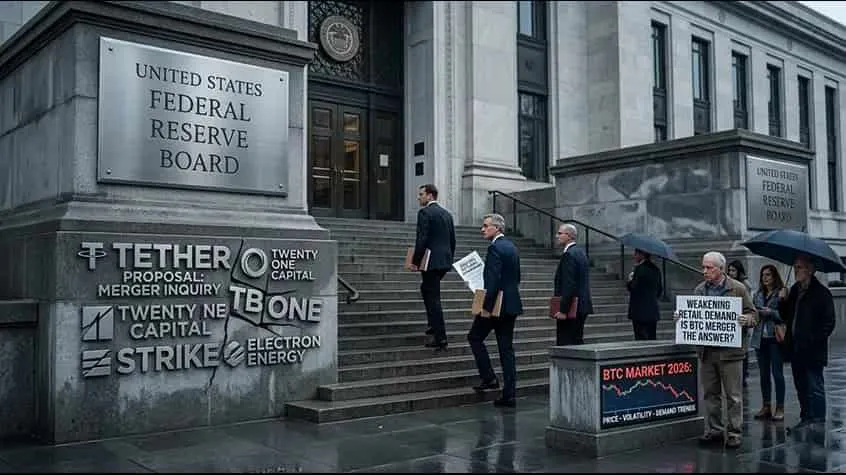

Tether Proposes a Vertically Integrated Bitcoin Powerhouse
On April 29, Tether Investments unveiled a plan to combine Twenty One Capital (XXI), Strike, and Elektron Energy under one roof. The goal is to create the world's leading publicly traded Bitcoin company — one that spans treasury holdings, mining, financial services, and lending, rather than functioning as a simple holding vehicle.
The proposal also includes a subsequent merger with Electron Energy, a large-scale Bitcoin mining platform. Tether believes this series of transactions will improve the financial condition of the resulting company, enhance profitability, and accelerate Bitcoin adoption.
The three entities each bring a distinct pillar to the proposed structure:
- Twenty One Capital (XXI): Went public via a SPAC merger in late 2024 and already holds roughly 43,500 BTC.
- Strike: Founded by Jack Mallers, it is a profitable, operational platform available in over 100 countries for buying, selling, custody, and borrowing against Bitcoin.
- Elektron Energy: Contributes approximately 50 EH/s of mining capacity — roughly 5% of the entire Bitcoin network — with production costs below $60,000 per bitcoin.
Leadership, Lending Products, and Market Reaction
Tether has recommended Raphael Zagury — founder and CEO of Electron Energy — to serve as president of the new company if the mergers succeed. Zagury brings extensive experience in Bitcoin mining, covering both technical and operational dimensions.
Mallers publicly backed the proposal and, at the Bitcoin 2026 Conference, unveiled new lending products including a $2.1 billion Bitcoin-backed credit facility with interest rates ranging from 10.5% APR for smaller loans down to 7.49% APR for amounts of $5 million or more. XXI stock jumped more than 8% in after-hours trading on the news.
The merger process remains in its early stages. Shareholders of Twenty One Capital and Strike must still vote, and regulatory approvals may be required before any transaction closes.
Fed Holds Rates as Macro Pressure Weighs on BTC
While the merger signals deepening integration among the ecosystem's largest players, the macroeconomic backdrop poses near-term challenges. The Federal Open Market Committee voted 8-to-4 to hold the federal funds rate at 3.5% to 3.75% — the most contentious decision in over three decades. The hawks cited rising global energy prices and ongoing uncertainty in the Middle East, dashing hopes for near-term rate cuts.
Matt Mena, a strategist at 21Shares, noted that the blocking stance of some Fed members poured cold water on investor hopes. Bitcoin reacted immediately, sliding to around $75,700 — down more than 3% on the week.
On-Chain Data Reflects Retail Retreat
The price pressure is also visible in on-chain metrics:
- Coinbase Premium Index: Turned negative for the first time in three weeks, signaling weakening US demand.
- Net realized losses: Hit $829 million for the week, compared to just $566 million in realized gains, according to CryptoQuant.
- Trading volume: Slumped below $8 billion — the lowest level since October 2023.
Analyst Axel Adler Jr. noted that investors who bought in around the turn of the year at prices above $80,000 used the April recovery as an exit opportunity. Negative net volumes on Binance's derivatives market confirm the ongoing selling pressure.
Institutions Continue Accumulating Despite Headwinds
Despite the retail pullback, institutional demand remains a structural counterweight. Strategy alone bought roughly 3,270 BTC between April 20 and 26 for approximately $255 million, bringing its total holdings to over 818,000 BTC. According to Bitwise CIO Matt Hougan, Strategy invested roughly $7.2 billion in Bitcoin over the past eight weeks, contributing significantly to the recent 20% recovery. Bitcoin ETFs have attracted nearly $3.8 billion in inflows since March.
In this thin-volume environment, the Tether-backed merger proposal serves a dual purpose: it is not just a corporate transaction, but a signal that the largest players are betting on long-term integration regardless of where the price sits today. Whether the deals close still depends on shareholder votes and regulatory approvals — but for now, Bitcoin's near-term fate hangs on a divided Fed and a retreating retail base, even as institutions quietly build positions for the next cycle.
Published by Coinplurk.com
We use AI technology to help present information faster and more efficiently. However, all content still goes through a human review process. If you find data errors or factual inaccuracies in this article, please report it to our editorial team via the [Report Article] button.
Published by Coinplurk.com
About the Author
CoinPlurk News
Verified AuthorVerified Web3 content architect providing high-impact data analysis and real-time reporting on the global blockchain ecosystem.
More Articles
6Visa, Mastercard, and 140+ Firms Launch Open USD Stablecoin
A coalition of Visa, Mastercard, Stripe, Coinbase, BlackRock, and more than 140 other companies has launched Open USD, a dollar-pegged stablecoin designed to share reserve yield with the businesses that use it.
FIFA Taps Avalanche for 2026 World Cup; AVAX Jumps 8%
FIFA's decision to build its 2026 World Cup ticketing, loyalty, and digital collectibles infrastructure on a dedicated Avalanche blockchain has given AVAX its strongest bullish signal in a month — but analysts say sustained demand still needs to be proven.
Mastercard Launches AP4M for AI Machine-Speed Payments
Mastercard's new Agent Pay for Machines (AP4M) service enables AI agents to autonomously permission, orchestrate, and settle high-frequency micro-payments across cards, bank accounts, and stablecoins — with more than 30 industry partners already on board.
Polymarket Eyes Japan With 2030 Approval Target
Polymarket has appointed a local representative and set a 2030 target for regulatory approval in Japan, even as the country's strict gambling laws and a global wave of prediction market restrictions make the path forward uncertain.
SpaceX IPO Filing Reveals $1.45B Bitcoin Treasury
SpaceX's landmark SEC filing ahead of its Nasdaq debut has disclosed an 18,712 BTC position worth $1.45 billion, placing the aerospace company among the largest known corporate Bitcoin holders.
Revolut's First Physical Crypto Card Goes Live in UK and EEA
Revolut has launched its first physical crypto debit card — a Dogecoin-themed, LED-equipped card accepted anywhere Visa and Mastercard are supported — marking a significant step in the fintech's push to bring digital asset spending into everyday consumer finance.
Interactive Hub
0 RepliesHave a suggestion, question, or just want to leave a comment on this article? Feel free to write in the discussion section below.
Please login to join the discussion
Login NowNo comments yet. Be the first!