








Meta Pays Creators in USDC via Stripe and Circle
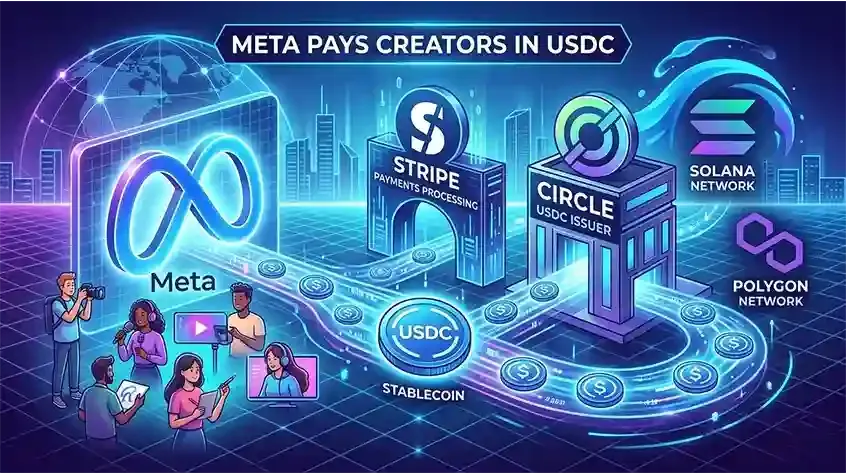

Meta Platforms has taken its most concrete step yet into the digital asset economy, quietly rolling out USDC stablecoin payouts for select creators in Colombia and the Philippines. The move positions Meta as the first consumer social platform at global scale to embed cryptocurrency payment rails directly into a domestic creator payout flow.
How the Payout System Works
The payouts are available on the Solana and Polygon blockchain networks and use the USDC stablecoin. On the infrastructure side, Stripe serves as the payment processor, with Circle providing the underlying USDC stablecoin.
Key operational details include:
- Creators who opt in will be prompted to enter their third-party crypto wallet address into Facebook's payout platform.
- Meta will not offer services to convert USDC into local currencies.
- Meta has also partnered with Stripe for crypto-specific tax reporting related to the stablecoin payouts.
- The initial rollout is limited; Meta has not publicly specified how many creators are included or which additional geographies are eligible.
In a statement to Fortune, a Meta spokesperson noted: "We strive to offer the most relevant payment methods, which is why we are exploring how stablecoins could become part of our suite of options."
A Calculated Return After Libra's Collapse
The launch carries significant historical weight. This comes four years after Meta pulled the plug on its earlier attempt to launch its own stablecoin through a project called Libra — later rebranded as Diem — which the company abandoned in 2022 after opposition from lawmakers. Rather than issuing a proprietary token again, the USDC integration represents a narrower, infrastructure-first approach that sidesteps the regulatory friction of issuing a company-controlled digital currency.
Last year, the company began reexploring stablecoins amid a more favorable regulatory environment under the Trump administration, and put out requests for help on its stablecoin project earlier this year.
Broader Industry Context
Meta's move is part of a wider institutional shift accelerated by regulatory progress. Following the 2025 passage of the GENIUS Act, which created a regulatory framework for dollar-backed stablecoins, major companies have started to make definite moves. Notable parallel developments include:
- Shopify has begun allowing merchants to accept USDC payments.
- Western Union announced plans to offer a stablecoin on the Solana blockchain.
- DoorDash and payments blockchain startup Tempo have begun working together on allowing DoorDash drivers to be paid in stablecoins.
- Visa separately announced on April 29 that it is expanding stablecoin settlement to five additional blockchains.
What to Watch
The pilot's scope will determine whether this becomes a permanent payout option or a limited experiment. Regulatory treatment of stablecoin payouts under U.S. money transmission law remains unsettled, and the absence of a fully signed federal stablecoin bill adds compliance uncertainty for any platform scaling this model. For now, Stripe's role as the processor and Circle's position as issuer suggest the infrastructure is ready — the binding constraint is now legal clarity, not technical readiness.
Published by Coinplurk.com
We use AI technology to help present information faster and more efficiently. However, all content still goes through a human review process. If you find data errors or factual inaccuracies in this article, please report it to our editorial team via the [Report Article] button.
Published by Coinplurk.com
About the Author
CoinPlurk News
Verified AuthorVerified Web3 content architect providing high-impact data analysis and real-time reporting on the global blockchain ecosystem.
More Articles
6Visa, Mastercard, and 140+ Firms Launch Open USD Stablecoin
A coalition of Visa, Mastercard, Stripe, Coinbase, BlackRock, and more than 140 other companies has launched Open USD, a dollar-pegged stablecoin designed to share reserve yield with the businesses that use it.
FIFA Taps Avalanche for 2026 World Cup; AVAX Jumps 8%
FIFA's decision to build its 2026 World Cup ticketing, loyalty, and digital collectibles infrastructure on a dedicated Avalanche blockchain has given AVAX its strongest bullish signal in a month — but analysts say sustained demand still needs to be proven.
Mastercard Launches AP4M for AI Machine-Speed Payments
Mastercard's new Agent Pay for Machines (AP4M) service enables AI agents to autonomously permission, orchestrate, and settle high-frequency micro-payments across cards, bank accounts, and stablecoins — with more than 30 industry partners already on board.
Polymarket Eyes Japan With 2030 Approval Target
Polymarket has appointed a local representative and set a 2030 target for regulatory approval in Japan, even as the country's strict gambling laws and a global wave of prediction market restrictions make the path forward uncertain.
SpaceX IPO Filing Reveals $1.45B Bitcoin Treasury
SpaceX's landmark SEC filing ahead of its Nasdaq debut has disclosed an 18,712 BTC position worth $1.45 billion, placing the aerospace company among the largest known corporate Bitcoin holders.
Revolut's First Physical Crypto Card Goes Live in UK and EEA
Revolut has launched its first physical crypto debit card — a Dogecoin-themed, LED-equipped card accepted anywhere Visa and Mastercard are supported — marking a significant step in the fintech's push to bring digital asset spending into everyday consumer finance.
Interactive Hub
0 RepliesHave a suggestion, question, or just want to leave a comment on this article? Feel free to write in the discussion section below.
Please login to join the discussion
Login NowNo comments yet. Be the first!