









Wasabi Protocol Loses $5M+ in Admin-Key Exploit

What Happened
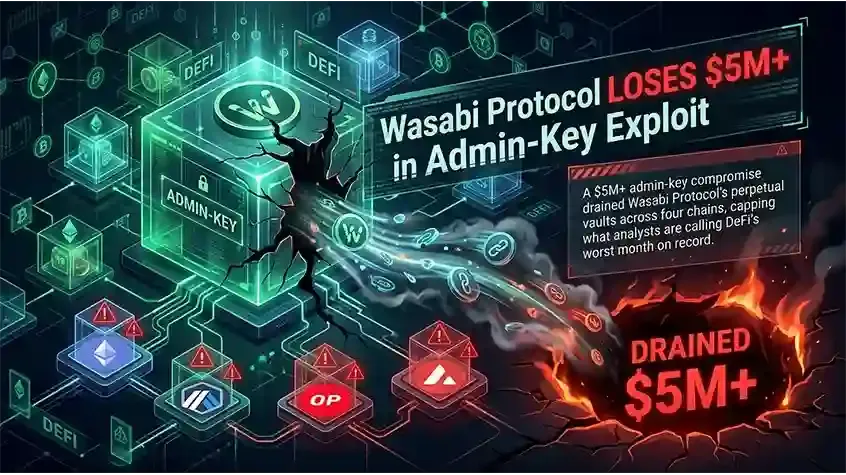
On-chain perpetual futures protocol Wasabi was hacked on April 30, 2026, with attackers draining over $5 million across Ethereum, Base, Berachain, and Blast, as blockchain security firm PeckShield reported.
The attacker gained ADMIN_ROLE through the protocol's deployer wallet — identified as wasabideployer.eth, the sole address holding that role in Wasabi's PerpManager AccessManager — then upgraded the vaults to a malicious implementation that siphoned user balances. Approximately $4.55 million had been extracted at initial count, with investigations still active.
Wasabi acknowledged the incident on X, urging users to avoid using the protocol while investigations are under way, and confirmed it had engaged professional on-chain security responders, including SEAL 911 and Blockaid.
We're aware of an issue and are actively investigating.
— Wasabi Protocol 🟢 (@wasabi_protocol) April 30, 2026
As a precaution, please do not interact with Wasabi contracts until further notice.
We'll share an update as soon as we have more information. Thanks for your patience.
How the Attack Was Executed
The attack was carried out through a mechanism known as a UUPS upgrade exploit. After compromising the deployer account, the attacker initiated a contract upgrade that replaced secure code with malicious logic, redirecting funds from vaults and liquidity pools into their own addresses. Because the protocol lacked a timelock mechanism, the changes were implemented instantly — leaving no window for developers or users to intervene.
Key technical details of the breach:
- The attacker called
grantRoleon the deployer EOA with zero delay, instantly converting their orchestrator contract into an admin. - Wasabi and Spicy LP-share tokens from affected vaults are flagged as compromised, with redemption value approaching zero.
- Blockaid noted the same attacker address, orchestrator contract, and strategy bytecode tie this incident to earlier activity targeting Wasabi.
- There were no safeguards such as multi-signature authorization or time delays to prevent immediate execution of malicious actions.
April 2026: DeFi's Worst Month on Record
The Wasabi exploit did not occur in isolation. The hack caps off a brutal month for DeFi, marked by two major exploits and over twenty smaller incidents. The former head of DeFi at Monad noted on X that April 2026 resulted in approximately $635 million lost across 28 incidents in 30 days.
The month's two largest incidents were:
- Drift Protocol — On April 1, the Solana-based perpetuals exchange suffered roughly $270 million in outflows spanning more than 15 distinct token types, in what was reported as a North Korean state-linked operation six months in the making.
- Kelp DAO — On April 18, an attacker suspected of being North Korean state-backed exploited a LayerZero bridge, forging a cross-chain message that allowed minting of 116,500 rsETH with nothing locked on the source side. The attacker then deposited the unbacked rsETH into Aave as collateral and borrowed approximately $236 million in real WETH.
The response to the Kelp incident has included an unprecedented collective effort among DeFi protocols and individuals, dubbed DeFi United, which has raised over $300 million to restore the backing of Kelp's rsETH.
The AI-Hacker Theory
The frequency and precision of recent exploits has renewed debate about the tools attackers are using. Developer Vitto Rivabella publicly floated a theory that North Korea trained an in-house AI model on years of stolen DeFi data, suggesting it now operates as an autonomous exploiter draining protocols faster than human reviewers can patch them. While unverified, the hypothesis reflects a growing concern in the security community about the asymmetric advantage attackers may hold over protocol defense teams.
What Users Should Do Now
Security teams are urging affected individuals to revoke all smart contract permissions associated with the protocol as a critical first step. Tools such as Revoke.cash can help remove access previously granted to compromised contracts. Users should avoid interacting with suspicious links or unofficial recovery programs and monitor only verified official announcements.
Whether or not AI is accelerating the current wave of exploits, the Wasabi incident makes one structural problem unmistakably clear: single-key admin architectures without timelocks or multi-signature controls remain among the most exploitable vulnerabilities in DeFi today.
Published by Coinplurk.com
We use AI technology to help present information faster and more efficiently. However, all content still goes through a human review process. If you find data errors or factual inaccuracies in this article, please report it to our editorial team via the [Report Article] button.
Published by Coinplurk.com
About the Author
CoinPlurk News
Verified AuthorVerified Web3 content architect providing high-impact data analysis and real-time reporting on the global blockchain ecosystem.
More Articles
6Visa, Mastercard, and 140+ Firms Launch Open USD Stablecoin
A coalition of Visa, Mastercard, Stripe, Coinbase, BlackRock, and more than 140 other companies has launched Open USD, a dollar-pegged stablecoin designed to share reserve yield with the businesses that use it.
FIFA Taps Avalanche for 2026 World Cup; AVAX Jumps 8%
FIFA's decision to build its 2026 World Cup ticketing, loyalty, and digital collectibles infrastructure on a dedicated Avalanche blockchain has given AVAX its strongest bullish signal in a month — but analysts say sustained demand still needs to be proven.
Mastercard Launches AP4M for AI Machine-Speed Payments
Mastercard's new Agent Pay for Machines (AP4M) service enables AI agents to autonomously permission, orchestrate, and settle high-frequency micro-payments across cards, bank accounts, and stablecoins — with more than 30 industry partners already on board.
Polymarket Eyes Japan With 2030 Approval Target
Polymarket has appointed a local representative and set a 2030 target for regulatory approval in Japan, even as the country's strict gambling laws and a global wave of prediction market restrictions make the path forward uncertain.
SpaceX IPO Filing Reveals $1.45B Bitcoin Treasury
SpaceX's landmark SEC filing ahead of its Nasdaq debut has disclosed an 18,712 BTC position worth $1.45 billion, placing the aerospace company among the largest known corporate Bitcoin holders.
Revolut's First Physical Crypto Card Goes Live in UK and EEA
Revolut has launched its first physical crypto debit card — a Dogecoin-themed, LED-equipped card accepted anywhere Visa and Mastercard are supported — marking a significant step in the fintech's push to bring digital asset spending into everyday consumer finance.
Interactive Hub
0 RepliesHave a suggestion, question, or just want to leave a comment on this article? Feel free to write in the discussion section below.
Please login to join the discussion
Login NowNo comments yet. Be the first!