









7 Proven Tips to Spot and Follow Smart Money Wallet Moves in 2026

Introduction: What Is "Smart Money" in the 2026 On-Chain Landscape?
The term smart money has evolved well beyond its traditional finance roots. In the 2026 crypto ecosystem, smart money refers to a distinct class of market participants whose on-chain behavior consistently precedes major price movements: venture capital firms deploying tokens from unlocked vesting schedules, high-conviction whale wallets holding eight or nine figures in digital assets, and increasingly, high-win-rate algorithmic bots executing MEV (Maximal Extractable Value) strategies and arbitrage loops with sub-block precision.
What distinguishes these actors from the retail crowd is not luck — it is informational asymmetry, sophisticated tooling, and the willingness to operate in low-signal environments. The core insight is that blockchain's immutable public ledger turns this asymmetry into an intelligence opportunity. Every swap, liquidity injection, and cross-chain bridge transaction is permanently timestamped and auditable. Unlike social media narratives — which are engineered, delayed, or deliberately misleading — on-chain data does not lie.
Following smart money via blockchain forensics is, therefore, not about mimicry. It is about constructing a probabilistic framework: identifying recurring behavioral signatures, filtering out noise, and forming independent theses informed by the movements of participants with demonstrated track records. The seven strategies below provide that framework.
Tip 1: Identify and Label "Seed" Wallets Using Funding Trail Analysis
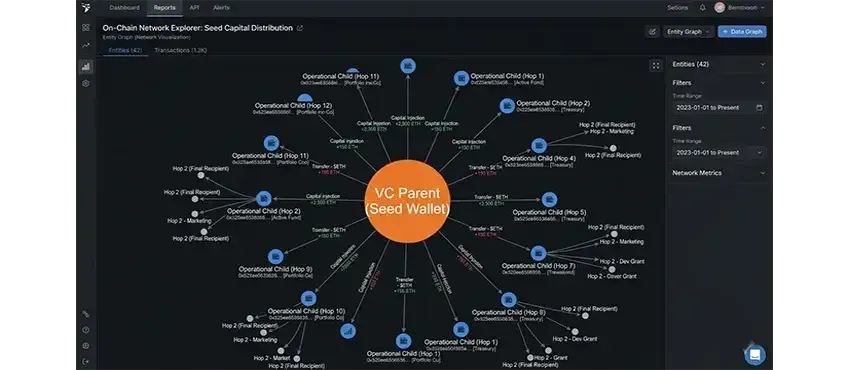
Every sophisticated market participant has an origin wallet — a seed wallet — from which initial capital was dispersed to operational addresses. Tracing this lineage is one of the most valuable exercises in wallet heuristics.
Begin with a known entity: a publicly disclosed VC wallet, a documented whale address, or an exchange withdrawal address tied to a high-value account. On tools like Arkham Intelligence or Nansen, use the "entity graph" feature to map outbound transactions from that seed address. Look for patterns: small ETH dust sent to multiple fresh wallets (a common operational security split), or staggered USDC deployments to wallets that later interact with new protocol contracts.
A seed wallet cluster rarely acts in isolation. When three or more wallets with a common funding ancestor begin accumulating the same low-cap token within a 72-hour window, that convergence constitutes a statistically significant signal — particularly if those wallets have historically exited positions at a profit.
Key metric: Track the funding depth — how many hops separate the observable wallet from a known exchange hot wallet or CEX withdrawal. Wallets two to four hops deep from a major exchange often belong to sophisticated actors attempting operational separation.
Tip 2: Filter Out Wash Trading Noise Before Drawing Conclusions
Wash trading — the practice of simultaneously buying and selling the same asset to simulate volume — is pervasive across DEX ecosystems and inflates on-chain signals. Before attributing significance to any large wallet movement, apply a wash-trading filter.
Diagnostic criteria for wash trading:
- The same wallet or a directly funded sibling wallet appears on both sides of a transaction within the same or adjacent blocks.
- Token trading volume dramatically exceeds its circulating market cap within a 24-hour window.
- Liquidity pool depth is thin, yet reported volume is disproportionately high.
- Token transfer events lack corresponding price impact, suggesting circular routing.
On Dune Analytics, community-maintained dashboards (search: "wash trade filter ERC-20") cross-reference token transfer logs against known circular routing patterns. Applying these pre-built queries before analyzing volume-based signals significantly reduces false positives in your smart money thesis.
Rule of thumb: If a wallet's PnL looks exceptional but its counterparties are self-funded, treat that performance record as unreliable for signal extraction.
Tip 3: Monitor DEX Liquidity Pool Injections as a Leading Indicator
Providing liquidity to a DEX pool, particularly to a newly deployed or thinly capitalized pool, is a capital-at-risk commitment. Unlike spot buys, LP injections require a degree of conviction — and they are visible in real time.
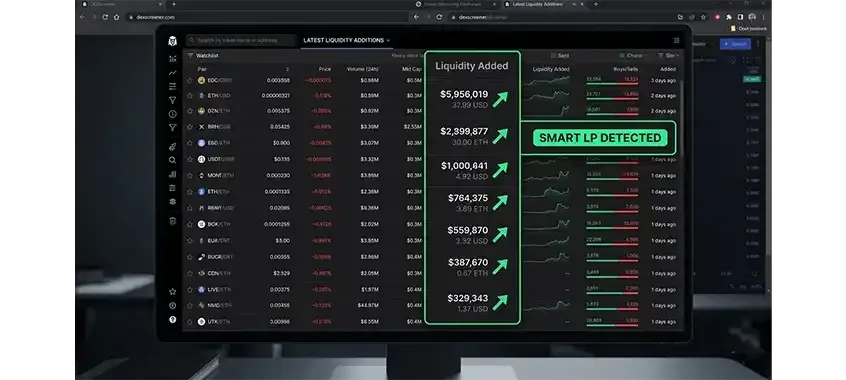
Significant single-wallet LP injections into pools involving a new token are often precursors to coordinated marketing campaigns or protocol announcements. The logic: a sophisticated actor deploying $500,000 in liquidity is not doing so speculatively; they expect volume and, by extension, swap fee revenue tied to incoming demand.
Use GeckoTerminal or DEXScreener's "Top Liquidity Providers" tab to identify wallets supplying disproportionate LP share in nascent pools. Cross-reference those wallets against Nansen's "Smart LP" label — a categorization based on historical LP profitability scores. Wallets that consistently added liquidity ahead of volume spikes and removed it near local tops demonstrate a behavioral pattern worth tracking.
Caveat: LP injection can also be a mechanism for concentrated rug-pull setups. Always verify token contract renouncement status and whether the deployer wallet retains mint authority.
Tip 4: Use Advanced Explorer Filters on Etherscan and Solscan
Block explorers remain the foundational layer of on-chain research, and their advanced filter capabilities are underutilized by most retail participants.
On Etherscan:
- Use the Token Holder tab sorted by balance change over 30 days to identify accumulation patterns.
- Filter Internal Transactions to identify smart contract interactions masked within simple ETH transfers.
- Use the Analytics tab on individual ERC-20 tokens to view transfer volume, unique senders/receivers, and holder concentration (Gini coefficient proxy).
On Solscan:
- The DeFi Activities tab on a wallet address aggregates all protocol interactions — staking, lending, swapping — into a readable activity log.
- Use Token Accounts to see a wallet's full SPL token portfolio across Solana.
- Cross-reference with Step Finance or Birdeye for aggregated PnL and historical trade reconstruction.
Advanced technique — Mempool Monitoring: For EVM chains, tools like Blocknative or bloXroute allow monitoring of pending transactions before block confirmation. Observing a whale wallet's pending swap before it executes provides a narrow but real timing edge, particularly in illiquid tokens where slippage is price-determinative.
Tip 5: Deploy Real-Time Wallet Alerts via Telegram and Discord Bots
Reactive research has limited value in fast-moving markets. The structural advantage comes from proactive monitoring: receiving alerts the moment a tracked wallet initiates a significant transaction.
Setup workflow:
- Identify 10–20 target wallets using the criteria above (seed wallet clusters, high-win-rate LPs, known VC operational addresses).
- Register those addresses in Nansen Portfolio Alerts, Whale Alert, or the open-source Debank Watch Telegram bot.
- Configure alert thresholds: e.g., any outbound ERC-20 transfer exceeding $50,000, or any new protocol interaction from a tracked wallet.
- Route alerts to a dedicated Discord channel using a webhook, with role-pings for high-priority wallets.
For Solana, SolanaFM's transaction webhook API allows custom alert pipelines for specific Program IDs or wallet addresses. Combine with a simple Python script to enrich alerts with token metadata before posting to Discord.
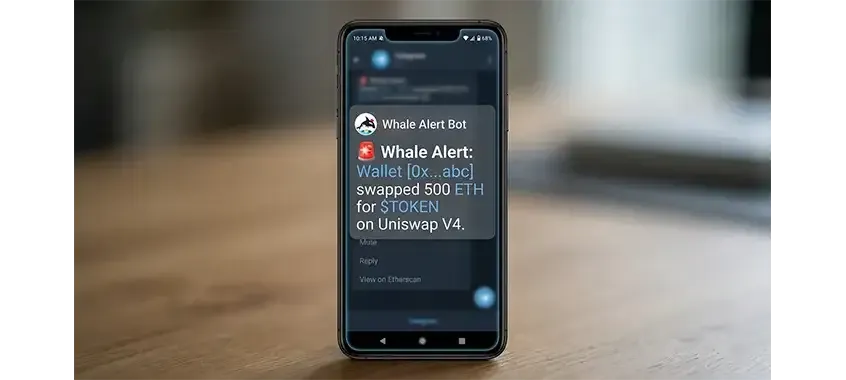
Critical discipline: Raw alerts are not trade signals. An alert triggers research — not execution. The alert tells you that a wallet moved; on-chain forensics tells you why.
Tip 6: Recognize and Avoid Copy-Trading Traps (The Exit Liquidity Problem)
This is the most consequential risk in smart money following: the deliberate construction of observable on-chain behavior to attract retail capital as exit liquidity.
The mechanics are straightforward. A sophisticated actor accumulates a position in a low-liquidity token. They then execute a series of visible, high-value buys — sometimes across multiple wallets they control — generating on-chain signal that monitoring tools surface to retail followers. As retail capital flows in and elevates the price, the original actor distributes their holdings into that incoming demand.
Behavioral red flags:
- A tracked wallet enters a position in a token with near-zero prior on-chain history.
- The token has a concentrated holder distribution (top 10 holders controlling >60% of supply).
- Buy transactions are uniformly round numbers (e.g., exactly 10 ETH, 50 ETH) — a pattern inconsistent with algorithmic or natural accumulation.
- The wallet's prior history shows several high-profit exits from tokens with similar structural profiles.
The antidote is independent fundamental verification. Before acting on any smart money signal, assess: What is the protocol's actual utility? Is there a credible development team? Does the token's on-chain activity (unique users, protocol revenue, TVL trajectory) support the valuation implied by the smart money entry price?
Data > signal mimicry. Blind replication of wallet moves, without independent thesis formation, is structurally disadvantaged.
Tip 7: Build a Multi-Chain Signal Stack and Cross-Validate Across Networks
In 2026, capital does not stay on one chain. Sophisticated actors operate fluidly across Ethereum, Solana, Base, Arbitrum, and emerging L2/L3 ecosystems. A signal that appears only on one chain may be incomplete or intentionally fragmented.
A robust smart money monitoring stack should include:
| Layer | Tool | Function |
|---|---|---|
| EVM Aggregation | Nansen, Arkham | Entity labeling, wallet clustering |
| Solana Native | Birdeye, SolanaFM | SPL token tracking, protocol PnL |
| Cross-Chain Bridges | Debridge Analytics, Li.Fi Explorer | Capital flow across chains |
| DeFi Protocol Layer | DefiLlama | TVL inflow/outflow by protocol |
| Mempool | Blocknative | Pending transaction monitoring |
| Custom Alerts | Dune + Telegram webhook | Parameterized on-chain event triggers |
Cross-validating a signal across chains provides higher conviction. If the same wallet cluster is deploying capital to an ecosystem's flagship DEX on L1 while simultaneously providing liquidity to the corresponding bridged version on L2, the thesis has multi-layer confirmation.
The "Pro" Layer: Operational Security and Signal Integrity
Beyond tool selection, professional on-chain analysts maintain strict signal discipline. This means maintaining a private tracking list that is not published on social media — publicizing target wallets degrades their signal quality as copycat behavior obscures the original actor's intent. It also means rotating tracked wallets quarterly, as sophisticated actors periodically migrate to fresh operational addresses precisely to eliminate followers.
Maintain a personal on-chain journal: timestamp each signal observation, record the hypothesis formed, document the outcome, and conduct post-mortems on both winning and losing trades derived from on-chain intelligence. This systematic feedback loop is what separates analysts from speculators.
Geo-Adaptation: Compliance, Legality, and Tax Implications
Is Tracking Public Wallets Legal?
Blockchain data is, by design, public and permissionless. Observing and analyzing on-chain transactions constitutes legal information gathering in virtually all jurisdictions. However, several important nuances apply:
Automated Copy-Trading: In jurisdictions where automated trading constitutes a regulated activity — including operating as an unlicensed investment advisor — replicating trades programmatically and commercially on behalf of others may require licensing. In the United States, the SEC and CFTC have both asserted jurisdiction over certain automated crypto trading services.
United States (IRS): The IRS treats cryptocurrency as property. Every taxable event — swap, LP exit, token receipt — must be reported. Capital gains from on-chain trading are subject to short-term (ordinary income rate) or long-term (0–20%) rates depending on holding period. Tools like Koinly or Cointracker automate on-chain transaction import for Schedule D filing.
Indonesia (Bappebti / DJP): Cryptocurrency trading in Indonesia is regulated by Bappebti (Badan Pengawas Perdagangan Berjangka Komoditi). Crypto assets are classified as commodities, not currencies. The Direktorat Jenderal Pajak (DJP) requires reporting of crypto gains as income; a final income tax of 0.1% on transaction value applies for transactions on registered exchanges. Gains from unregistered DEX activity may be subject to general income tax provisions. Consult a local tax professional for cross-chain DEX reporting obligations.
European Union: Under MiCA (Markets in Crypto Assets Regulation), effective across EU member states, certain automated trading services may require authorization. Individual investors are subject to national capital gains tax regimes, which vary significantly by country.
General Principle: On-chain analysis for personal investment decision-making is universally legal. Operating a commercial copy-trading service, managing others' funds without authorization, or failing to report taxable gains all carry legal and regulatory risk. Engage qualified legal and tax counsel in your jurisdiction.
Conclusion: Data Over Emotion — The Enduring Edge
The thesis underlying all seven strategies is singular: on-chain data is the most objective, real-time, and manipulation-resistant signal available to any market participant with an internet connection. Social media narratives, influencer endorsements, and community sentiment all contain embedded incentive structures that misalign with your financial interests. On-chain data does not.
Applying the methods outlined here — seed wallet tracing, wash trade filtering, LP monitoring, advanced explorer analysis, real-time alerting, exit liquidity awareness, and multi-chain cross-validation — does not guarantee profitable outcomes. Markets are probabilistic systems. What these methods provide is a structured, repeatable process for forming higher-conviction theses grounded in observable behavior rather than narrative.
The discipline is: collect signal, form hypothesis, verify independently, size positions according to conviction, and review outcomes systematically. That process, compounded over hundreds of market cycles, constitutes a genuine and durable analytical edge.
Frequently Asked Questions
➤ Q1: Is it legal to track private wallets on-chain?
Blockchain wallets are pseudonymous, not private — all transactions are publicly recorded on-chain and accessible to anyone. Analyzing this data for personal investment research is legal in virtually all jurisdictions. The legal boundary is crossed when you use this information to operate an unauthorized investment service, engage in market manipulation, or — in some jurisdictions — combine on-chain data with off-chain personally identifiable information to identify individuals without consent. For personal, analytical use: publicly available on-chain data is fair game.
➤ Q2: What are the best free on-chain tools available in 2026?
Several high-quality tools remain free at their base tier. Etherscan and Solscan provide comprehensive transaction-level data without cost. Dune Analytics offers a free tier with access to thousands of community dashboards covering DEX volumes, wallet cohort analysis, and protocol metrics. DefiLlama provides free TVL, revenue, and fee data across 200+ protocols and 50+ chains. GeckoTerminal and DEXScreener offer real-time DEX pair analytics at no cost. For wallet monitoring, Debank provides free portfolio tracking and transaction history across EVM chains. Advanced labeling (Nansen, Arkham) and mempool access (Blocknative) require paid subscriptions for full functionality.
➤ Q3: How do you distinguish between a whale wallet and an exchange hot wallet?
Exchange hot wallets have several distinguishing characteristics: they interact with thousands of unique counterparties daily (retail withdrawals and deposits), they receive and send funds in highly irregular amounts (reflecting user activity, not strategic positioning), they are typically labeled by block explorers and analytics platforms (Etherscan's "Binance: Hot Wallet" labels, for example), and they rarely interact directly with DeFi protocols like Uniswap or Aave. A genuine whale wallet, by contrast, has a concentrated set of counterparties, executes deliberate protocol interactions, holds a diversified but curated token portfolio, and often shows evidence of operational security practices like intermediate wallet layering. When in doubt, check Arkham or Nansen's entity database — most major exchange hot wallets are already labeled.
We use AI technology to help present information faster and more efficiently. However, all content still goes through a human review process. If you find data errors or factual inaccuracies in this article, please report it to our editorial team via the [Report Article] button.
Published by Coinplurk.com
About the Author
CoinPlurk News
Verified AuthorVerified Web3 content architect providing high-impact data analysis and real-time reporting on the global blockchain ecosystem.
Interactive Hub
0 RepliesHave a suggestion, question, or just want to leave a comment on this article? Feel free to write in the discussion section below.
Please login to join the discussion
Login NowNo comments yet. Be the first!