








How Top Traders Use Dexscreener to Find 100x Memecoins

Introduction: The On-Chain Edge That Separates Pros from Retail
The difference between a trader who caught a 100x and one who bought the top isn't luck — it's timing, methodology, and the right tools. By the time a memecoin appears on Binance or Coinbase, the explosive early price discovery has usually already happened. The real alpha lives on-chain, and the professionals who harvest it consistently use one tool above all others: Dexscreener.
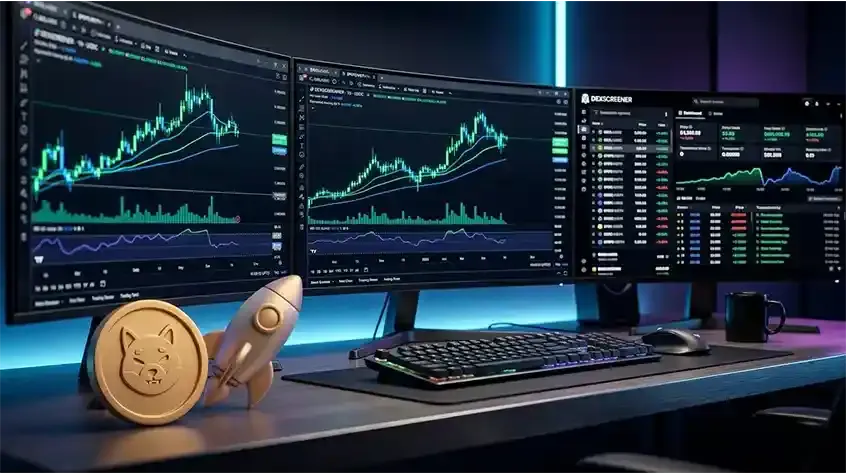
Dexscreener is a real-time DEX (Decentralized Exchange) analytics platform that aggregates trading data across hundreds of chains — Ethereum, Solana, Base, BNB Chain, and dozens more. It surfaces live token pairs, liquidity metrics, holder behavior, and social signals in a single interface. For traders who know how to read it, it functions as an early-warning system for tokens that are weeks or months away from mainstream attention.
This guide breaks down the exact methods top traders use — the filters, the signals, the verification steps — so you can build a systematic approach to finding high-potential tokens before the crowd arrives.
Part 1: Understanding What Dexscreener Is Actually Showing You
Before touching any filters, you need to understand the data model. Every row in Dexscreener represents a trading pair, not a token. A single token can have dozens of pairs across multiple DEXs and chains. This distinction matters because it affects how you interpret volume and liquidity figures.
Key metrics to internalize:
- Liquidity (USD): The total value locked in the AMM pool. Low liquidity means high slippage and high manipulation risk.
- Volume (24h): Raw trading activity. Can be faked via wash trading, so always cross-reference with unique wallet count.
- Txns (5m / 1h / 6h / 24h): Transaction count across time windows. A rising ratio of buys-to-sells across short windows is a behavioral signal.
- Price Change %: Short-term momentum. The 5-minute and 1-hour columns are where early breakouts first become visible.
- Age: How long the pair has existed. Tokens under 24 hours old carry maximum risk but also maximum upside potential.
- FDV (Fully Diluted Valuation): The implied market cap if all tokens were in circulation. A $50M FDV on a token with $10K liquidity is a red flag, not a buying signal.
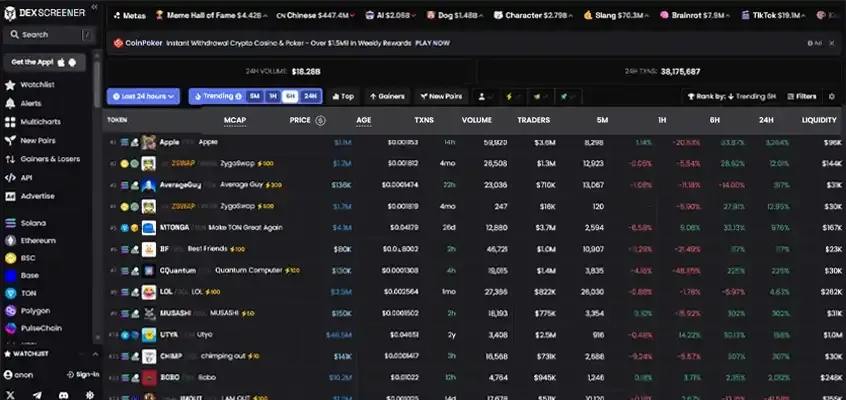
Understanding these metrics as a system — not individually — is the foundation of everything else.
Part 2: The Filter Stack That Professionals Use
Dexscreener's filter panel is where most traders stop. Professionals use it as a first pass, not a final answer. Here is a proven filter configuration for hunting early-stage memecoins on Solana (the chain with the highest memecoin velocity), adaptable to other chains:
Initial Screening Filters:
- Min Liquidity: $30,000 — filters out honeypots and illiquid traps
- Min Volume (24h): $100,000 — confirms genuine market interest
- Min Transactions (24h): 500 — validates organic activity
- Max Age: 72 hours — keeps focus on newly launched tokens
- Min Buys/Sells Ratio (1h): 1.5x or higher — confirms buying pressure dominates
What this filter stack does: It eliminates the 95% of new tokens that are either rugs, dead launches, or projects with zero community traction — and surfaces the 5% worth a second look.
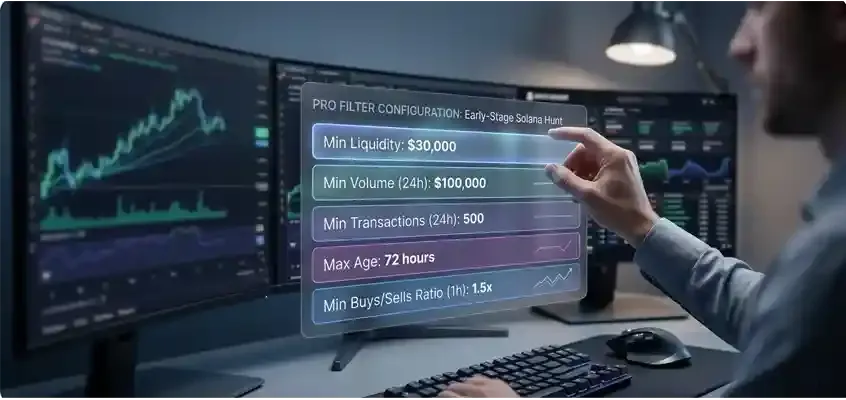
Pro Note: The filter thresholds above are starting points. Adjust the liquidity minimum upward on Ethereum (where gas costs require larger pools to function efficiently) and downward on faster, cheaper chains like Base or Avalanche.
Part 3: Reading the Pair Page — The Intelligence Report
When you click into a token pair on Dexscreener, you reach what experienced traders treat as an intelligence report. Here is what to analyze and in what order:
1. The Liquidity Audit Check whether liquidity is locked (indicated by a lock icon or verifiable via Unicrypt/Team.Finance). Unlocked liquidity means the developer can drain the pool instantly. Locked liquidity with a time duration of 6+ months is a baseline safety signal.
2. The Holder Distribution Dexscreener links to on-chain explorer data. Pull up the holder list. If the top 10 wallets control more than 40% of supply, concentration risk is extreme. Look for a relatively broad distribution across hundreds or thousands of wallets early in a token's life.
3. The Transaction Pattern Scroll through recent transactions. Healthy early-stage tokens show a mix of small buys from many unique wallets — not recurring large buys from two or three addresses. Recurring large buys from the same wallet often indicate a developer or team accumulating before a pump-and-dump.
4. The Social Footprint Verification Dexscreener displays linked social profiles (Twitter/X, Telegram). Click through and check: Is the Twitter account recently created? Does the Telegram have real conversation or just bots sending emojis? Low-quality social infrastructure is a red flag regardless of how good the chart looks.
5. The Contract Audit Status Look for the audit badge. Unaudited contracts are not automatically scams, but audited contracts from reputable firms (CertiK, Hacken, SolidProof) provide a meaningful layer of protection.
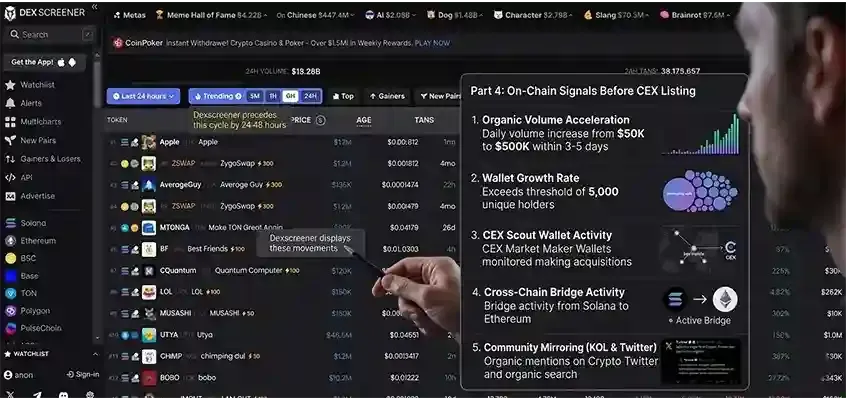
Part 4: On-Chain Signals That Precede CEX Listings
Professional traders don't just find tokens early — they find tokens that go somewhere. Here are the behavioral signals that frequently precede exchange listings:
Organic Volume Acceleration: A token that goes from $50K daily volume to $500K over 3-5 days without a major influencer push suggests genuine grassroots community growth. Exchanges watch these curves.
Wallet Growth Rate: Use a tool like Bubblemaps or the chain's native explorer to track unique holder growth. Tokens crossing the 5,000 unique holder threshold attract exchange due diligence teams.
CEX Scout Wallet Activity: Some traders maintain lists of wallet addresses known to be associated with exchange market-making desks. When these wallets acquire a token before any announcement, it's a strong forward signal. Dexscreener's transaction history makes these movements visible.
Cross-Chain Bridge Activity: A token launching on Solana that begins to see bridge activity to Ethereum often signals that the team is preparing for a broader market push — a move exchanges respond to.
Community Mirroring: When KOLs (Key Opinion Leaders) on Crypto Twitter begin organically mentioning a token — not in sponsored posts — organic search volume rises. Dexscreener's trending section frequently leads this cycle by 24-48 hours.
Part 5: Security Best Practices for On-Chain Token Trading
High-reward environments attract sophisticated fraud. The following practices are non-negotiable for traders operating in the memecoin space:
Use a Burner Wallet for New Tokens
Never connect your primary wallet — the one holding significant assets — to new token contracts. Create a dedicated wallet funded with only the capital you intend to trade with. A single malicious contract approval can drain everything in a connected wallet.
Revoke Approvals Regularly
Use tools like Revoke.cash or De.fi Shield to audit and revoke token approvals. Every time you interact with a contract, you may grant it ongoing permission to move your tokens. Revoke unused approvals weekly if you are an active trader.
Verify the Contract Address
Before purchasing any token, verify the contract address from the official project source — not from a reply tweet, not from a Telegram message. Contract address scams (where fraudsters deploy a near-identical token to the real one) are common in high-hype launches.
Set a Slippage Limit
High slippage settings (above 5%) expose you to sandwich attacks by MEV bots. Use private RPC endpoints like Flashbots Protect on Ethereum or Jito on Solana to reduce MEV exposure.
Never Share Your Seed Phrase
No legitimate tool, auditor, Dexscreener support account, or exchange will ever ask for your seed phrase or private key. This request, in any context, is a scam.
Position Size Discipline
The asymmetric upside of memecoins comes with asymmetric downside risk. Professional traders typically risk no more than 1-3% of their portfolio per speculative position. The 100x that matters is the one you were sized correctly for.
FAQ
Q: Is Dexscreener free to use?
Yes. Dexscreener's core features — live pair data, charts, transaction history, and filters — are free to access without an account. Some advanced features and API access may require registration or a paid tier, but the screening methodology described in this article is fully executable on the free version.
Q: How do I tell the difference between a legitimate early-stage token and a rug pull on Dexscreener?
No single signal is definitive, but the combination of locked liquidity, distributed holder wallets (not concentrated in top 5-10 addresses), an audited or renounced contract, and organic (not bot-driven) transaction patterns significantly reduces rug pull risk. A token failing on two or more of these checks should be treated as high-risk regardless of how its chart looks.
Q: Does Dexscreener work for all blockchains?
Dexscreener covers a large and growing number of EVM-compatible chains as well as non-EVM chains like Solana and Tron. Coverage varies by chain — newer or smaller chains may have partial data. Always confirm you are viewing the correct chain when analyzing a token, as the same token symbol can exist as different (and sometimes fraudulent) contracts across chains.
Q: What is the difference between Dexscreener and Dextools?
Both are DEX analytics platforms. Dexscreener is generally regarded as faster with cleaner multi-chain UX and stronger filtering for new token discovery. Dextools has a more established community audit system (DEXT score) and richer historical data on Ethereum pairs. Many professional traders use both: Dexscreener for discovery and Dextools for validation on Ethereum-native tokens.
Conclusion: Building a Systematic On-Chain Process
The traders who consistently find tokens before CEX listings aren't doing so through luck or insider information. They have built a repeatable process: systematic filtering on Dexscreener, multi-layer verification of on-chain signals, strict security hygiene, and disciplined position sizing.
The tools are free. The methodology is learnable. The edge comes from executing it consistently while the majority of retail participants are still waiting for Binance to make the announcement for them.
Start with the filter stack. Build your verification checklist. Practice the security hygiene. Over time, reading an on-chain token launch becomes as intuitive as reading a price chart — and significantly more profitable at the early stages.
We use AI technology to help present information faster and more efficiently. However, all content still goes through a human review process. If you find data errors or factual inaccuracies in this article, please report it to our editorial team via the [Report Article] button.
Published by Coinplurk.com
About the Author
CoinPlurk News
Verified AuthorVerified Web3 content architect providing high-impact data analysis and real-time reporting on the global blockchain ecosystem.
Interactive Hub
0 RepliesHave a suggestion, question, or just want to leave a comment on this article? Feel free to write in the discussion section below.
Please login to join the discussion
Login NowNo comments yet. Be the first!